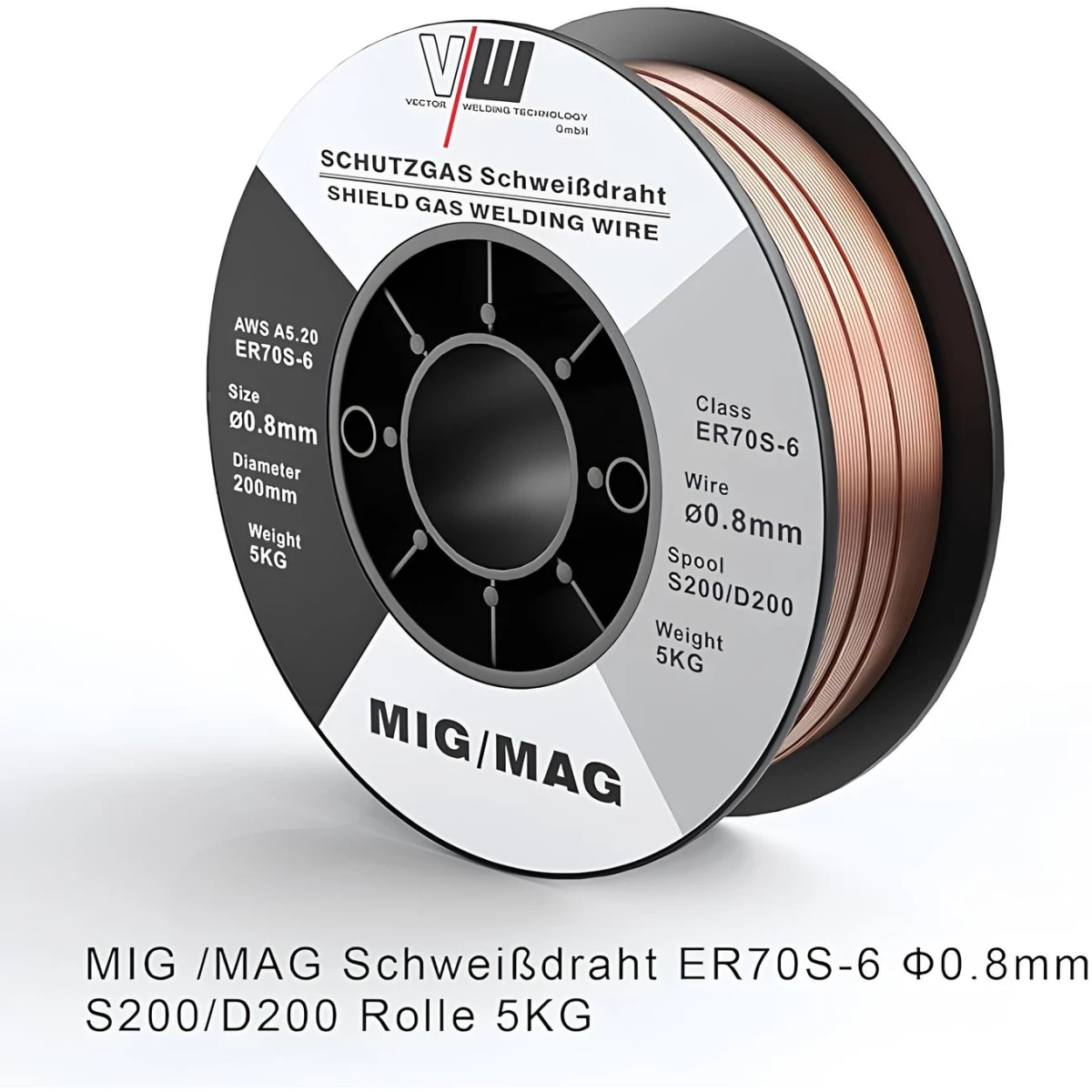
MIG/MAG: Welding with automatic wire feed. MIG welding uses argon (rarely helium) as the shielding gas and is the preferred method for non-ferrous metals and stainless steel. The MAG process uses CO2 or a mixed gas of argon, CO2 and O2 as shielding gas and is mainly used for simple and low-alloy steel such as mild steel.
Settings according to wire thickness: If you set the wire thickness (0.6 | 0.8 | 1), a preset amperage (A) and wire feed speed will appear, adjusted to the selected wire thickness. The amperage can be changed within the specified range. Amperes are linked to volts.
Wire control: Inspection of welded wires on disk shafts.
2 cycle/4 cycle (MIG/MAG, Plasmaschneider and TIG)
MMA/STICK/E-HAND: coated electrodes are used - in this process the electrodes are arc carriers and filler metal in one.
Hotstart: each time the welding machine is restarted, overcurrent is provided to support the ignition of the arc.
Arc Force: Molten material transfers more easily to the workpiece. Prevents the arc from extinguishing if this material causes contact between the electrode and the weld pool.
Anti-stick automatically switches off the welding generator if the electrode sticks to the workpiece and has to be removed by hand without damaging the electrode clamp.
DC TIG welding (optional: only possible with additional hosepack and cables): Welding of almost all metals
Adjustable in TIG mode ( basic current pulse current/down slope current reduction/current increase/pulse frequency pulse frequency/pulse width/gas overrun).
Modern IGBT (Insulated Gate Bipolar Transistor) enables fast and therefore low-loss switching of electrical currents.
Welding mode with pulse function and HF/lift ARC.
Plasma cutter: The plasma cutter uses compressed air to create a plasma arc that can weld all materials.
Optimum ignition behavior with pilot ignition, can cut grid workpieces.
Overheating protection